
Commercial Floor Stripping and Waxing in MA, RI, and CT
Winter salt deposits and abrasive silica sand are actively grinding away your VCT and terrazzo surfaces. We deploy aggressive mechanical stripping, pH-balancing chemistry, and zinc-crosslinked acrylic finishes to protect commercial floors across the New England industrial and life science corridors.
Zero-Residue Strip
Deep polymer breakdown with low-odor, pH-neutralized chemistry.
2,000 RPM Burnish
Thermal friction cures high-solids finish for scuff resistance & DCOF.
Rapid Regional Dispatch
Fast crew response for Route 128, I-495, Providence & I-91 corridors.
Network-backed quality standards & regional dispatch across MA, RI, & CT. Projects are fulfilled through fully vetted, licensed, and insured local commercial floor care partners. Itemized quotes within 24 business hours.
Industrial wet/dry recovery systems
Night & weekend off-hours scheduling
Rapid regional dispatch corridors
Transparent square-footage pricing
Request an Itemized Square-Footage Estimate
Whether you manage a 5,000 sq ft biotech lab in Waltham or a 100,000 sq ft logistics facility along I-495, we evaluate your floor condition, traffic patterns, and provide transparent per-square-foot pricing.
Commercial Facility Estimate
Provide your facility specs for an itemized response within 24 hours.
The New England Environmental Threat: Calcium Chloride and Abrasive Tracking
The Symptom:
Your vinyl composition tile (VCT) or terrazzo floors have turned a hazy, dull yellow. Heavy foot traffic lanes feel slightly sticky in high humidity, and the surface scratches easily under the weight of pallet jacks or medical carts.
The Cause:
Facilities operating along the I-95 Coastal Commercial Belt (Stamford to New Haven) and the Blackstone Valley Industrial Belt (Pawtucket to Millbury) face severe winter conditions. Property managers rely heavily on calcium chloride and rock salt to melt ice. When tracked inside, this highly alkaline brine chemically attacks and softens standard floor finishes. Combined with native New England silica sand carried in on work boots, the mixture acts like 80-grit sandpaper. It grinds directly through the protective wax layers, exposing the porous tile underneath to permanent moisture damage and structural failure. Furthermore, severe freeze-thaw cycles shift concrete subfloors, causing compromised, poorly waxed tiles to crack and lift.
The Engineered Solution:
New England Floor Strip and Wax utilizes a rigid chemical neutralization protocol that standard janitorial crews skip. After stripping the damaged layers, we saturate the floor with a specialized acidic neutralizer, pulling the surface pH down from a highly caustic 12+ (caused by ice melt and stripping agents) back to a neutral 7.0. This prevents "alkaline blush"—the cloudy haze that ruins new finish—and ensures the subsequent layers of our proprietary high-solids floor coatings establish a permanent molecular bond with the substrate.
Immediate Technical Guidance
Need an immediate chemical assessment of salt brine damage or yellowed acrylic coatings?
Click to Call: (401) 336-6117Mechanical Stripping Protocols for High-Traffic Commercial Hubs
Removing five to ten years of degraded, cross-linked floor finish requires exact mechanical force combined with aggressive chemical dwell times. In environments like the Route 128 Life Sciences Corridor (Woburn, Burlington, Waltham) or the Hartford-Springfield Knowledge Corridor, downtime is unacceptable. We execute a systematic, highly controlled stripping operation designed for speed, safety, and total finish removal.
1. Dwell Time and Chemical Breakdown
We flood the floor with a professional-grade, butyl-based floor stripper. We maintain the solution in a liquid state for precisely 10 to 15 minutes. Allowing the stripper to dry re-adheres the melted wax to the floor like concrete. Our crews work in isolated, manageable grids to prevent premature evaporation, a critical step during the dry winter months inside heated New England facilities.
2. Rotary Agitation
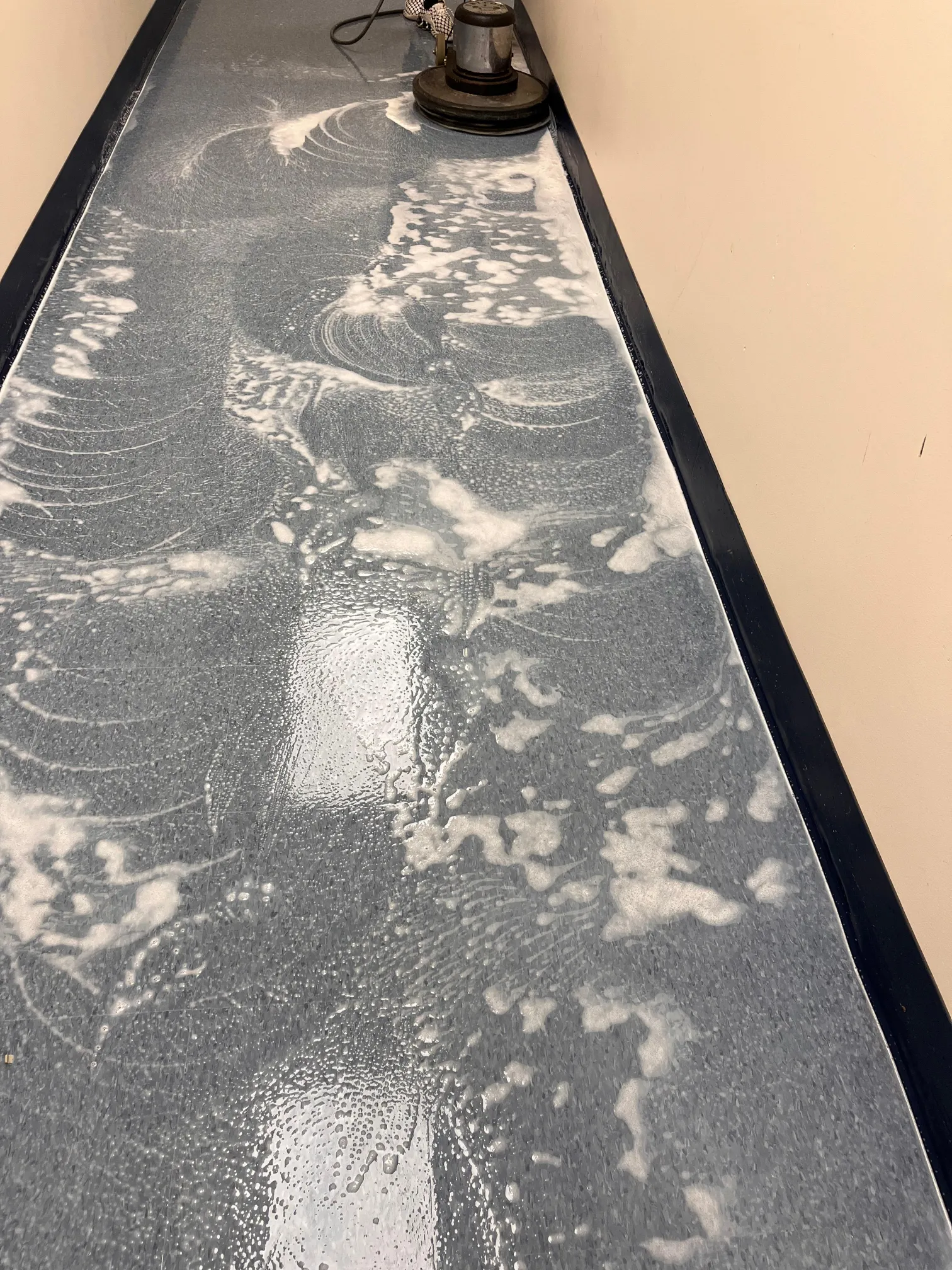
We deploy heavy-duty, 175 RPM rotary floor machines equipped with aggressive black stripping pads or specialized wire-mesh grit brushes. The mechanical friction shears the chemically softened layers of dirt and old acrylic finish away from the tile surface without gouging the VCT.
3. Slurry Extraction
Using wet/dry vacuums equipped with front-mount squeegees, we extract the toxic, highly alkaline slurry immediately. Leaving any slurry behind results in immediate re-contamination.
4. Edge and Corner Detailing
Automated machines cannot reach tight baseboards or the corners of a room. We manually scrape all perimeter edges with specialized hand-tools, removing the dark bands of built-up wax that standard cleaning crews leave behind.
5. Multi-Stage Neutralizing Rinse
We rinse the bare floor multiple times using fresh water mixed with a neutralizing acid. We test the floor’s surface with pH strips to confirm absolute neutrality before introducing any new polymers.
🛑 EMERGENCY FLOOR RESTORATION
Are your floors chalking, peeling, or failing state compliance inspections? Delaying maintenance exposes porous subflooring to irreversible water damage.
Call New England Floor Strip and Wax at (401) 336-6117 for immediate deployment across MA, RI, and CT. Network-backed standards & insured partner dispatch.
Click-to-Call (401) 336-6117
Polymer Chemistry and High-Solids Floor Coating Application
Applying the new finish requires strict environmental controls and advanced polymer chemistry. We utilize high-solids, zinc-crosslinked acrylic finishes. The zinc acts as a chemical structural binder, linking the acrylic molecules together into an impenetrable, resilient grid. This specific compound is engineered to withstand the heavy rolling loads found in the I-495 MetroWest Logistics Arc (Marlborough, Westborough, Franklin) and the South Coast Industrial Corridor (Fall River, New Bedford, Dartmouth).
We lay down a minimum of four to six distinct coats, depending on the facility's traffic volume. The application process is rigorously timed:
- Pore Sealing:The first two coats act as primers. They penetrate the microscopic pores of the stripped VCT or terrazzo, establishing the foundation.
- Build Coats:Subsequent coats build the structural thickness, creating the wear layer that absorbs the impact of foot traffic and silica sand.
- Humidity and Temperature Control:During application, especially in the humid Narragansett Bay Metro Ring (Providence, Warwick, Cranston), we manipulate HVAC systems and utilize high-velocity air movers. Acrylic polymers must cure evenly. If the surface dries faster than the bottom, moisture gets trapped, causing the finish to powder and fail under pressure.
Regional Compliance, Slip Resistance, and Environmental Controls
Commercial facility managers in Massachusetts, Rhode Island, and Connecticut face stringent safety regulations. Wet floors, inadequate finishes, and improper maintenance directly violate OSHA safety protocols and increase liability.
Our finishing processes strictly adhere to the ANSI A137.1 standards for Dynamic Coefficient of Friction (DCOF). By selecting the correct polymer finishes and executing high-speed burnishing (running at 1,500 to 2,000 RPM), we harden the wax to a brilliant shine without creating a slick, dangerous surface. The thermal friction of the burnisher literally melts the top microscopic layer of the acrylic, smoothing out imperfections and locking the surface structure. This increases the floor's slip resistance, ensuring compliance and safety for employees and customers alike.
Furthermore, we manage chemical disposal strictly in line with state environmental regulations, ensuring that no caustic strippers or zinc-laden polymers enter local aquifers or violate municipal wastewater ordinances from the I-91 Central Connecticut Logistics Spine (Meriden, Wallingford, Middletown) down to the coast.
🏢 COMMERCIAL CONTRACT ESTIMATES
Managing a logistics center, medical facility, or retail hub? Protect your flooring investment with precision chemical stripping and high-solids polymer coatings.
Dial (401) 336-6117 to schedule an on-site mechanical assessment with New England Floor Strip and Wax.
Click-to-Call (401) 336-6117Service Area & Regional Corridors
Industrial-grade rotary stripping and high-solids polymer finishes dispatched across Massachusetts, Rhode Island, and Connecticut. Scheduled during overnight and weekend shifts to eliminate facility interruption.
Route 128 / I-495 MetroWest
High-tech life science laboratories, corporate parks, and high-cube logistics hubs along the I-95/Route 128 beltway and I-495 outer arc.
Greater Boston
Urban core commercial towers, academic research centers, biotech incubators, and municipal facilities across the inner metro transit ring.
Providence / Rhode Island Metro
Healthcare complexes, historical mill conversions, packaging facilities, and coastal distribution warehouses along Narragansett Bay and Blackstone Valley.
Central/Coastal Connecticut
Dedicated coverage across the Hartford-Springfield Knowledge Corridor, the I-91 Central Logistics Spine, and the I-95 Long Island Sound commercial belt. Rapid regional dispatch with fully self-contained mechanical equipment.
Frequently Asked Questions (PAA Structured)
Clear technical explanations for facility directors and operations managers.
Have a customized facility specification?
Our operations team reviews custom square footages and off-hour shift schedules.